What Biblical Sites Are in Egypt? A Complete Guide for Christians
Most Christians think of Egypt primarily as a backdrop to Moses and the Exodus. The real biblical significance of Egypt is far richer — and more personal — than that.
Egypt appears throughout both testaments: Abraham sought refuge there. Joseph saved a nation from famine there. Moses was born, hidden, and called by God there. The Holy Family fled there to protect the infant Jesus. The early church established some of its most enduring traditions there.
Here is a complete guide to the biblical sites in Egypt that Christian travelers should know about.
Cairo: The Pharaohs of the Exodus and the Holy Family
The Egyptian Museum of Antiquities in Cairo houses one of the most significant biblical artifacts available to any traveler: the mummies of the Pharaohs.
Most biblical archaeologists and Egyptologists identify Amenhotep II as the Pharaoh of the Exodus — the ruler who refused Moses’ demands and witnessed the ten plagues. His mummy is in the Cairo Museum. So is the mummy of Thutmose III, his father, and Hatshepsut — the Egyptian princess who found Moses in the Nile and raised him as her own (Exodus 2:5–10). These are not abstract historical figures. Their preserved remains are in a glass case in Cairo, and standing before them changes how you read those chapters.
Coptic Cairo — the oldest Christian neighborhood in the city — contains what may be the most overlooked biblical site in Egypt: the Church of St. Sergius, built over a cave where tradition holds that the Holy Family sheltered during their flight from Herod (Matthew 2:13–15). This is a site of Christian pilgrimage since at least the 5th century. The Hanging Church, also in Coptic Cairo, is one of the oldest churches in Africa.
The Nile: Where Moses Was Hidden as a Baby
The Nile runs through the entire biblical narrative of Egypt. It is where Moses’ mother placed him in a basket of reeds when the Pharaoh ordered the death of Hebrew male infants (Exodus 2:3). It is where the first plague turned water to blood. It is the source of life for the civilization that enslaved Israel.
Sailing the Nile between Aswan and Luxor — which is part of our Egypt biblical tour itinerary — gives you a physical sense of the geography that shaped the Exodus story. The scale of Egypt’s ancient power, visible in the temple complexes along the Nile, makes the plagues and the Exodus more comprehensible as events that took place in a civilization of this magnitude.
Luxor: The Valley of the Kings and the Temple of Hatshepsut
The Valley of the Kings contains the tombs of the New Kingdom Pharaohs, including Amenhotep II — the Pharaoh most often identified with the Exodus. Entering his tomb and seeing the hieroglyphs and burial paintings of the ruler who faced Moses is an experience that biblical travelers consistently describe as one of the most powerful of the trip.
The Temple of Hatshepsut, across the Nile from Luxor, honors the woman most likely to be Moses’ Egyptian mother — the daughter of Pharaoh who found him in the Nile and raised him in the palace. The temple is dramatic and well-preserved. Standing there while reading Exodus 2 is different from reading it anywhere else.
Mount Sinai: Where Moses Received the Ten Commandments
Mount Sinai — the traditional site of the giving of the Law (Exodus 19–20) — is the spiritual center of an Egypt biblical tour. The ascent begins at approximately 2 AM to reach the summit at sunrise.
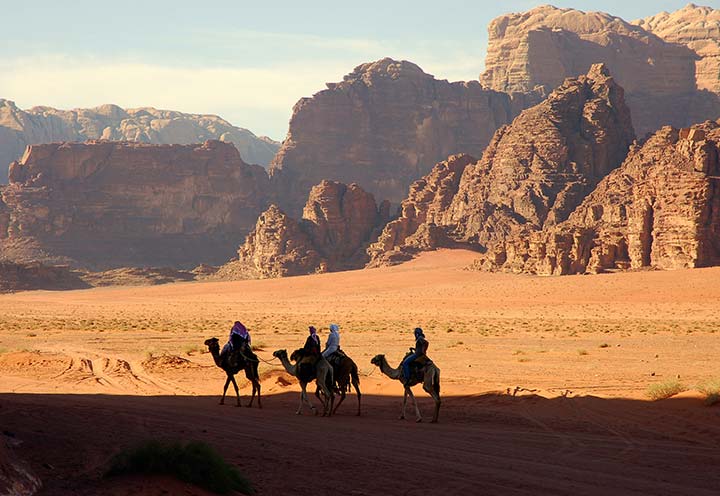
Two routes exist: the Camel Path (2–3 hours, gentler gradient) and the 3,750 Steps of Repentance (steeper, more dramatic). Most participants in their 50s and 60s complete the climb. At the summit, as the sun rises over the Sinai Peninsula, the group reads Exodus 19–20 in the place where it happened.
It is worth noting that archaeologists continue to debate the exact location of the biblical Sinai — some evidence points to Jabal al-Lawz in Saudi Arabia rather than the Sinai Peninsula. The traditional mountain has been a site of Christian pilgrimage since at least the 3rd century. Whatever the precise location of the biblical event, the experience of climbing in the dark and arriving at the summit at dawn is one that travelers describe in terms that match no other moment on the trip.
St. Catherine’s Monastery: The Oldest Active Monastery in the World
At the base of the traditional Mount Sinai stands St. Catherine’s Monastery — founded in 548 AD, still active today, a UNESCO World Heritage Site, and one of the most historically significant Christian sites on earth.
The monastery houses the Burning Bush — or what tradition identifies as the descendant of the original (Exodus 3:2). It contains ancient manuscripts including the Codex Sinaiticus, one of the oldest complete copies of the Christian Bible. Its icon collection is among the finest surviving examples of Byzantine art anywhere in the world. Greek Orthodox monks have lived and worshipped here continuously for nearly 1,500 years.
Entry requires modest dress and respectful behavior. The monastery is a place of active religious life, not a museum.
The Exodus Route: Walking the Path of Israel
Our Egypt biblical tour includes a day traveling the Exodus Route — the path the Israelites likely took from Egypt through the Sinai wilderness. This includes crossing the Suez Canal area, passing through the region of the Land of Goshen (where Israel lived in Egypt), and stopping at Marah and Elim, sites referenced in Exodus 15.
The route makes the scale of the Exodus comprehensible in a way that reading about it cannot. Forty years in this wilderness — you understand the Israelites differently when you’ve driven through it.
What makes an Egypt biblical tour different from a regular Egypt trip
A standard Egypt tour visits the Pyramids, takes a Nile cruise, and admires ancient temples. A biblical tour to Egypt does all of that — and then opens Genesis 41 when you’re standing where Joseph administered grain distribution, reads Exodus 2 in Coptic Cairo, and recites Deuteronomy 34 at the conclusion of the Moses sites.
The difference is the guide and the intentionality. Egypt’s monuments are remarkable as history. They are transformed when you encounter them as Scripture.
👉 Our 11-day Egypt biblical tour includes airfare from New York, Nile Cruise, and Mount Sinai. Departures: September 15, 2026. → View the Egypt tour page
Almost everyone who goes on a biblical tour to Israel says the same thing when they come back: “I read the Bible differently now.” It’s hard to explain before you go. The Galilee looks smaller than you imagined. Jerusalem feels more compressed and layered. The sites are closer together than the maps suggest. And standing […]
This is the first question almost every traveler asks us. And it deserves an honest answer — not a sales pitch, not a blanket reassurance, and not a worst-case-scenario warning either. Here’s what we actually know, what the data says, and how to make a thoughtful decision about whether to travel to Israel in 2026. […]
Someone has said that for many Christians, church history began with the first Billy Graham crusade. They think that as long as they derive their beliefs from the Bible, they can ignore the two thousand years of history between the apostles and the present. A Reformation tour is what happens when Christians decide to learn […]
In the Book of Revelation, Jesus dictated seven letters to seven real churches in what is now western Turkey. He praised some. He criticized others. He warned all of them. Those churches are still there. The ruins are accessible. You can visit them in one trip. And when you stand in them and read the […]